 Rich Pasewark - CEO, Board Director
Turning Risk Ratings Inside Out: Transforming Cybersecurity Metrics for Real-World Impact
 Ray Hicks : Jan 16, 2025, 7:55:22 AM
Risk ratings are a staple in cybersecurity, but are they truly living up to their potential?
 Experiencing an active breach? Call us immediately at 1-866-405-9156 UncommonX has experienced ZERO reportable breaches.


Risk ratings are a foundational element of nearly every cybersecurity strategy. They’re meant to help organizations prioritize vulnerabilities, streamline responses, and ultimately reduce risk across the enterprise. But somewhere along the way, many risk rating systems lost their way.
Instead of providing clarity, traditional risk ratings often add noise. Teams are left overwhelmed with alerts that lack meaningful context, leading to analysis paralysis and inaction. We see this every day—organizations trying to improve their posture while drowning in data points that don’t reflect the real threats they face.
That’s why, at UncommonX, we’ve taken a different approach. We believe risk ratings should do more than describe vulnerabilities. They should drive action. This is the philosophy behind our Relative Risk Ratings (R3), a unique capability of our patented Exposure Management Platform.
Risk ratings were originally intended to provide insight into what matters most. But in today’s environments, they’ve become too focused on raw activity. They tell you what’s happening, but not why it matters or what to do next.
When alerts lack context, they lead to fatigue. Security teams can’t tell the difference between noise and signal. This is especially true in mid-market organizations where lean teams are tasked with protecting complex environments.
Effective cybersecurity starts with clarity. Our goal with R3 is to restore that clarity by aligning risk scoring with business impact. We turn ratings into a decision-making tool, not just another dashboard metric.
At its core, the UncommonX Relative Risk Rating (R3) is a real-time framework that reflects your actual cybersecurity posture. Unlike generic risk scores, R3 is dynamic, contextual, and built to drive action.
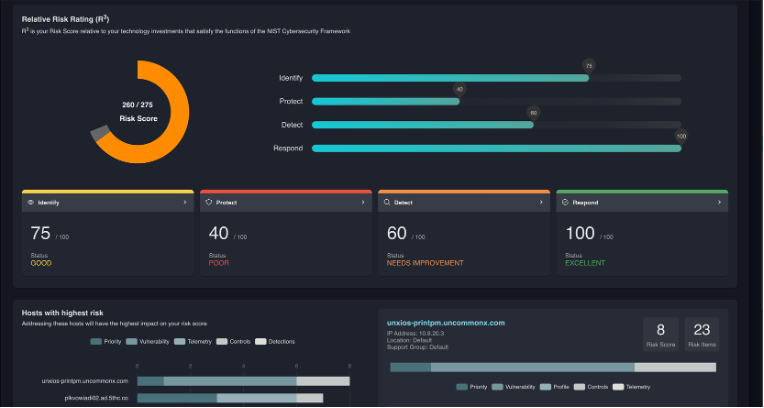
This structure provides both a strategic and operational view of risk, allowing leadership to understand organizational posture while enabling IT and security teams to act on specific threats.
Every R3 score includes deep host-level analysis, helping prioritize actions based on real business risk.
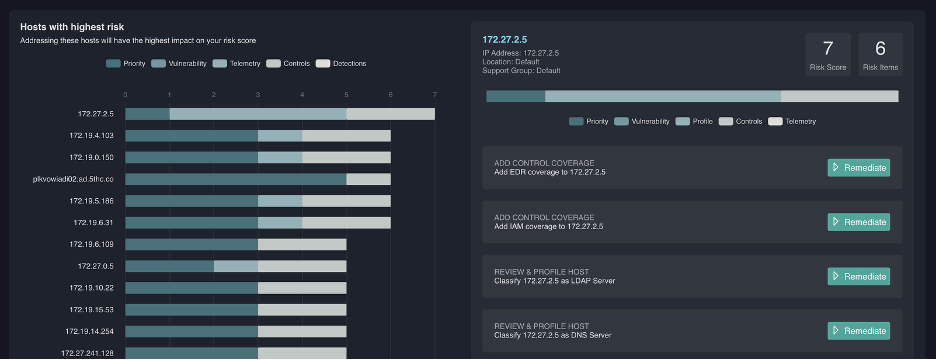
This gives security teams the power to not only identify high-risk areas but also understand why they are high-risk and most importantly, how to address them.
The value of R3 isn’t just in the math. It’s in how it translates across the organization. From analysts to CISOs, everyone gets a clear, prioritized view of what needs attention.
Because R3 is natively built into every UncommonX deployment, our Security Operations Center leverages the same insights our customers do. This shared context builds trust and speeds response times.
Cybersecurity complexity isn’t slowing down. Attack surfaces are expanding, threats are evolving, and teams are stretched thin. In this environment, generic metrics are no longer good enough.
What organizations need are impact-driven, contextualized risk scores that lead to better decisions. This is where UncommonX’s R3 changes the game.
We didn’t build R3 to be another checkbox. We built it to be a signal that cuts through the noise and gives teams what they need to protect their environments with confidence and precision.
If the answer is “no” to any of these, it’s time to rethink your approach.
UncommonX’s Relative Risk Ratings are built into our AI-powered Exposure Management Platform, helping organizations turn insights into outcomes.
Whether you’re leading strategy or managing infrastructure, R3 gives you the clarity, prioritization, and actionability you need to stay ahead of threats and improve your cybersecurity posture over time.
Contact us today to learn how UncommonX can help transform your risk metrics into a competitive advantage.

Ray Hicks : Jan 16, 2025, 7:55:22 AM
Risk ratings are a staple in cybersecurity, but are they truly living up to their potential?
 Rich Pasewark - CEO, Board Director : Mar 9, 2026, 6:01:05 PM
We posted recently on the unique composition and actionability of UncommonX Relative Risk Ratings (R3). As discussed, these ratings are not an...

Rich Pasewark - CEO, Board Director : May 28, 2025, 7:38:22 AM
Universities are not built for central control. They are built for autonomy, exploration, and collaboration across disciplines, departments, and...